Q4 2021
HP 1CPQ Product Design Team
Building a global high-performance team from scratch
Context
In 2020 I joined HP Inc. as Principal Experience Designer on the 1CPQ (Configure, Price, Quote) team inside the Commercial organisation. The workload was manageable at first. But as CPQ set out to deliver more products and more features for HP partners, the need for more designers stopped being a matter of opinion.
The team serves external users (HP resellers and distributors) and internal ones, HP sales representatives among them. The objective is that every market adopts the tools successfully, with a shorter turnaround time behind them, so business runs smoother for HP partners.
This study is about the part that was never drawn in Figma: making the case for a design team with the evidence to carry it, and then building one from the ground up, global and remote.
How I thought about it
I raised it in a 1:1 first. I told the program director I wanted to hire, and my reason was not that the team was unhappy or that quality was slipping. It was that I could see myself becoming the bottleneck. He did not say no. He said bring me evidence.
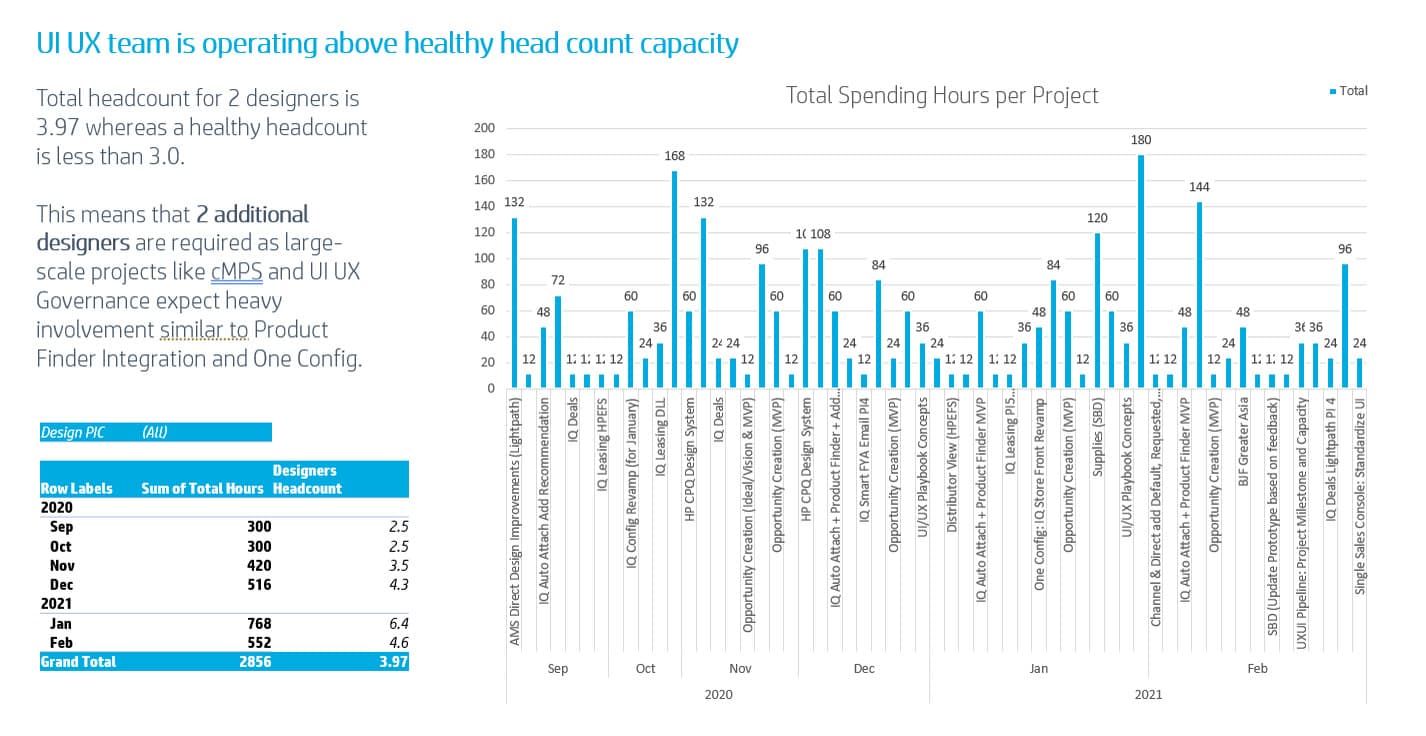
So I started clocking what design work actually took. My own hours and my design partner’s, the two of us on Config and Quote, project by project, from September 2020 through February 2021.
Six months came to 2,856 hours against the 1,440 that two people can hold — 3.97 times what one designer should carry in that window, where HP’s own ceiling was 3.0. The team was not stretched in the way people usually mean when they say it. It was carrying close to a second team’s worth of work, and now there was a number for that.
The hours on their own only described the past. To argue about the increments ahead I had to size the work, so I sorted every project into three tiers by what it cost over six months, then priced the upcoming ones at the floor of their tier. That is where the ~4,500 came from, and it is the number the ask rested on.
I took three options rather than one: three junior designers, or two seniors, or one staff-level designer. Same problem, three different shapes, and I wanted the decision to be about which shape the program needed rather than whether I deserved help.
Management approved the first option, and chose to hire step by step rather than all at once. What gave way in the meantime was UI/UX governance. It was in the forecast as large-scale work, it never sat on a PI, and so it became day-to-day work absorbed around everything else rather than work anyone was resourced to do. That is the same reason it had been invisible before I started counting: the tracking only saw what had an epic number attached, and governance never did.
The bottleneck resolved, and the team kept growing alongside what the epics needed. That was the part that mattered more than the headcount itself. Once the work could be sized, adding people stopped being an argument and became a calculation.
Outcome & Impact
1 → 7
Designers on the team
From one in 2020 to seven by 2024, across Config, Price, Quote and Sales Experience.
2,856 hrs
Clocked in six months
By two designers, against the 1,440 hours a healthy six months holds.
~4,500 hrs
Forecast, the eight after
Around 19% more per month than the six months behind it, which were already carrying 3.97 times one designer’s healthy load. This is the number the headcount case rested on.
14 of 28
Epics deployed
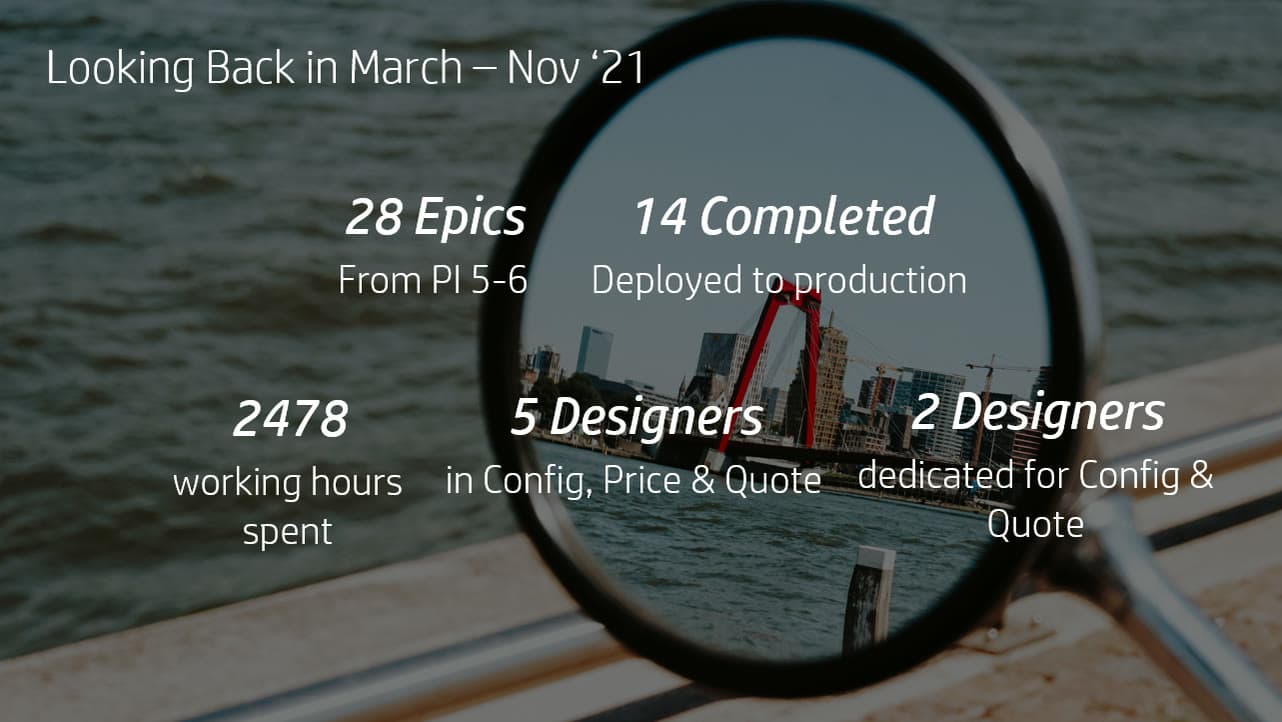
Shipped to production across PI 5 and PI 6, March to November 2021.
Measuring workload
In 2020 the CPQ team moved product development onto agile. Each stream runs on a Product Increment as its release train, and every PI carries many projects at many scopes: a feature improvement in one, a whole new product for a new business in the next.
So I started counting. From September 2020 to February 2021 I logged the hours my design partner (who joined two months after me) and I actually spent, project by project, as the foundation for forecasting the PIs ahead. What came back was not a matter of feeling stretched: between the two of us we were carrying 3.97 times one designer’s healthy load, against HP’s own ceiling of 3.0.
Projects breakdown
To forecast the eight months ahead (two PIs) from the six behind us, every project first had to be sized. I sorted them into three tiers by the hours they take over a six-month window.
Two designers should ideally clock 1,440 hours over that window: 120 hours a month, each, for six months. We clocked 2,856. The team was over-utilised by 1,416 hours. That is a second team’s worth of work, absorbed by the two people already there.
Large scale
501 hrs +
Over six months, more than two Product Increments of a single stream.
Medium scale
251 – 500 hrs
Over the same six months.
Small scale
Up to 250 hrs
Over the same six months, averaging 80.
Healthy load, 2 designers · Any six months
1,440 hrs
Clocked · Sep 2020 – Feb 2021, six months
2,856 hrs
Forecast · Mar – Oct 2021, eight months
~4,500 hrs
Large scale
501 hrs and above
- Opportunity creation
- 744 hrs
- cMPS
- 96 hrs
- Supplies (SBD)
- 168 hrs
- One Config
- 204 hrs
- Product Finder integration
- 456 hrs
- HP CPQ design system
- 456 hrs
Medium scale
251 – 500 hrs
- Business justification form
- 60 hrs
- IQ Deals
- 264 hrs
Small scale
Up to 250 hrs
- IQ Leasing
- 156 hrs
- Smart FYA email
- 84 hrs
- Pre-OPG sync-back
- 12 hrs
- Quoter page, channel & direct
- 12 hrs
- Direct design improvements, APJ & AMS
- 144 hrs
Total, two designers
2,856 hrs
Forecast
Pricing each project at the floor of its tier (the minimum for large and medium scale, the 80-hour average for small), the same two designers were on course to clock about 4,500 hours between March and October 2021. That is ~4,500 hours across eight months against 2,856 across the six behind us, about 19% more per month, on top of six months that had already broken the ratio.
The forecast is what turned the ask into arithmetic: two more designers, needed for large-scale work like the Quoter landing page redesign and UI/UX governance, neither of which had anyone to give it to.
Large scale
7 at the 501-hr floor
- Opportunity creation
- PI 5
- cMPS
- PI 5, PI 6
- Supplies
- PI 6
- One Config
- PI 5, PI 6
- Product Finder integration
- PI 5
- UI/UX governance
- Not on a PI
- Quoter landing page redesign
- PI 6
Medium scale
3½ at the 251-hr floor
- Business justification form
- PI 5
- EUV automisation
- PI 5, PI 6
- IQ Deals
- PI 5
Small scale
2 at the 80-hr average
- IQ Leasing
- PI 5, PI 6
- Smart FYA
- PI 5, PI 6
Forecast, March – October 2021
~4,500 hrs
Result
Management approved the headcount, and chose to grow the team step by step rather than all at once.
Looking back from the Q4 review, the forecast had been low. At the cutoff, 14 of the 28 epics had cost 2,478 hours between the two of us, every small and medium one plus four large, and the 14 still in flight were almost all large-scale. The full set was tracking above the ~4,500 I had forecast. The tiers sized small and medium work well and undersized large work, which makes sense: I had less completed large-scale work to calibrate against when I built them. If I ran it again I would treat the 501+ tier as a range rather than a single floor. The forecast still did its job, and the direction of the error worked against me rather than for me, which is the safer way to be wrong when you are asking for headcount.
Here is where March to November 2021 landed.
Grow
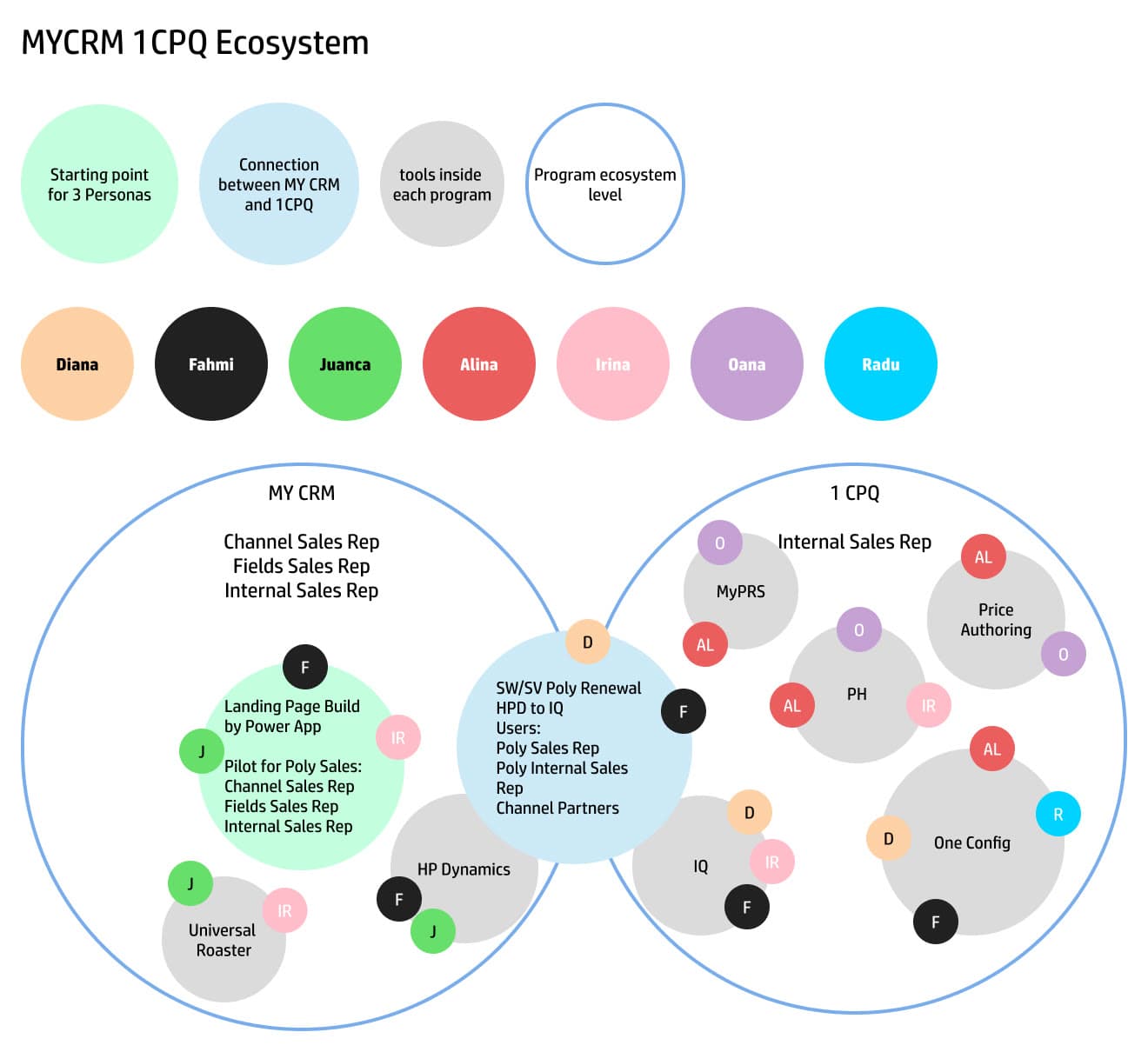
By 2024 the CPQ design team had gone from one designer to seven, with each workstream (Config, Price and Quote) served by name, and Sales Experience (MyCRM) added as a fourth focus. The map below is how we kept that legible: every program in the ecosystem, and the designers standing behind it.